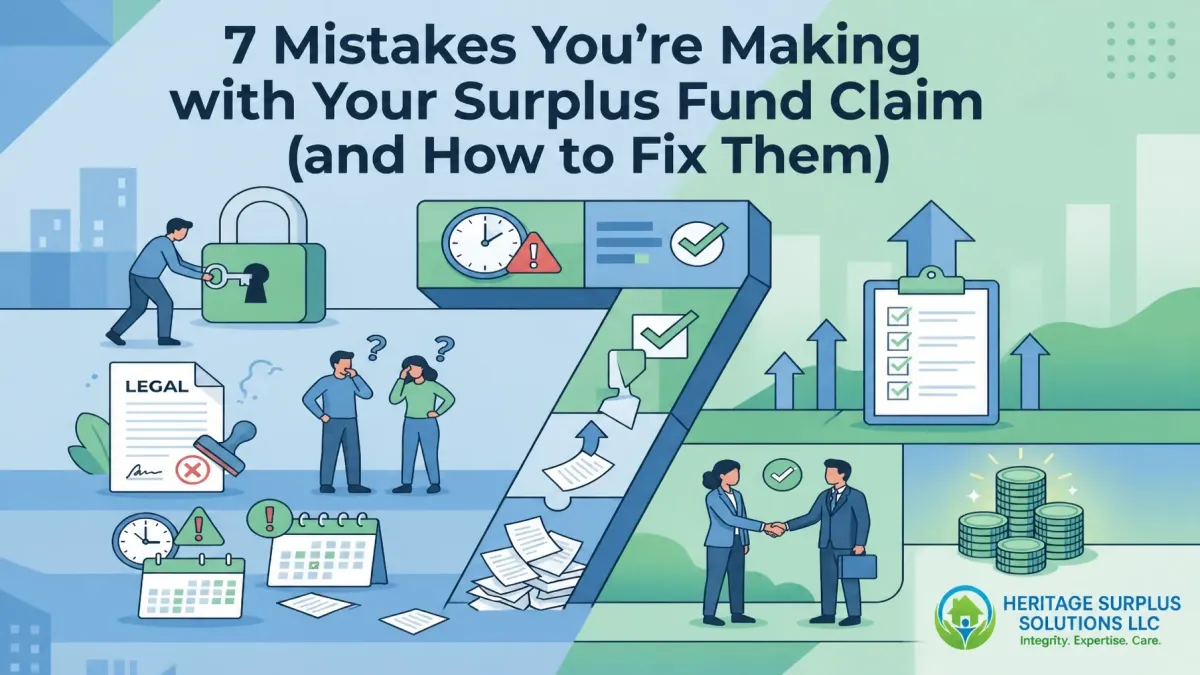
7 Mistakes You’re Making with Your Surplus Fund Claim (and How to Fix Them)
If you’ve recently gone through a foreclosure, first of all, I want to say I’m so sorry. I know how heavy that season can be. It feels like the world is crashing down, and the last thing you want to do is deal with more legal paperwork.
But here’s the thing we talk about a lot here at Heritage Surplus Solutions: foreclosure isn't always the "end" of your financial story. Often, there’s money left over after the bank or the county gets paid. These are called surplus funds (or excess proceeds), and they belong to you.
The problem? The process of getting that money back is like walking through a minefield. One wrong step and the county gets to keep your cash. I’ve seen so many people lose out on thousands of dollars, sometimes life-changing amounts, because of simple mistakes.
Let’s grab a virtual coffee and chat about the seven biggest mistakes people make when trying to claim their surplus funds, and more importantly, how you can fix them before it’s too late.
1. Letting the Clock Run Out (The Deadline Trap)
In Georgia, and specifically in places like Fulton County, money doesn't just sit in a vault waiting for you forever. There are strict statutes of limitation. If you don’t file your claim within a certain window, that money "escheats" to the state. That’s just a fancy legal word for "the government keeps it."
The Fix: You need to act the moment the foreclosure sale is finalized. Don’t wait for a letter in the mail that might never come. Check the status of your sale and find out exactly how much was left over. If you aren't sure where to start, our FAQ page has some quick tips on timing.
2. Knocking on the Wrong Door
I can’t tell you how many people call the wrong department. They’ll call the bank that foreclosed, or they’ll call the general city hall. Surplus funds are usually held by very specific offices, like the County Clerk of Superior Court or the Sheriff’s Office, depending on if it was a judicial or non-judicial foreclosure.
The Fix: Before you send a single document, verify who is actually holding the check. In Fulton County, the process for a tax sale surplus is different from a mortgage foreclosure surplus. Make a phone call first to confirm the "custodian of funds."

3. The Paperwork "Small Stuff" (That’s Actually Big Stuff)
The government loves its forms. If you miss a signature, forget to get something notarized, or use an outdated version of a form, they will toss your application into the "rejected" pile without a second thought. They aren't going to call you to fix it; they’ll just wait for you to give up.
The Fix: Double-check, no, triple-check: every line. Are the names spelled correctly? Is the property address exact? Most importantly, make sure your signatures are witnessed by a Notary Public where required.
4. Ignoring Junior Lienholders
This is a "gotcha" that catches a lot of homeowners off guard. You might think you’re owed $50,000, but if you had a second mortgage, a home equity line of credit (HELOC), or a stray contractor’s lien on the house, those people get paid out of the surplus before you do.
The Fix: You need to know exactly who else has a claim on that money. If you try to claim the full amount without accounting for a junior lienholder, your claim could be tied up in court for months in what’s called an "interpleader" action. It’s much better to know the numbers upfront so you aren't blindsided.
5. The Name Game (Discrepancies)
Did you get married since you bought the house? Did you buy it under a trust or an LLC? If the name on your current ID doesn't perfectly match the name on the deed from ten years ago, the county is going to flag it for potential fraud. They are (rightfully) protective of the money, but it makes things hard for you.
The Fix: Collect your "paper trail." If your name changed, you’ll need a marriage certificate or divorce decree. If the owner passed away and you are the heir, you’ll need probate documents showing you have the legal right to claim the estate’s funds.
6. Filing and "Ghosting"
A lot of folks think that once they mail the envelope, the check will just show up in the mail two weeks later. Unfortunately, that’s not how the wheels of bureaucracy turn. Claims get lost, people go on vacation, and files sit on desks.
The Fix: You have to be your own best advocate. Keep a log of every person you talk to, the date, and what they told you. If you haven't heard anything in 30 days, call for an update. Being "politely persistent" is the secret sauce to getting paid.
7. Falling for the "Upfront Fee" Scammers
This breaks my heart. There are "recovery agents" who will call you and say they can get your money, but they need $1,000 upfront for "processing fees." Never do this. Legitimate help either comes in the form of a DIY resource you buy once, or a contingency-based service where they only get paid after you get your money.
The Fix: Be skeptical of anyone who reaches out to you with high-pressure tactics. If you want to know more about how to spot these guys, check out our post on foreclosure surplus scams vs. legitimate help.
How to Get It Right the First Time
I know that list looks a bit daunting. You’re already stressed, and now you have to worry about junior lienholders and notary stamps? It’s a lot.
That is exactly why I created the Fulton County DIY Surplus Claim Kit, and it’s coming soon.
Look, you can hire an attorney to do this, but they often take 30% to 50% of your money. For a $40,000 check, that’s twenty grand just for filling out paperwork! I don’t think that’s right. You’ve already lost your home; you should keep as much of your equity as humanly possible.
Our DIY Kit is designed specifically for Fulton County. It’s the "insider’s roadmap" that will show you exactly:
Which office to file with.
Which forms you actually need (and provides them!).
How to check for those pesky liens.
The exact step-by-step process to follow so you don't get rejected.

The guide and kit are coming soon. It’s designed to be simple, compassionate, and: most importantly: effective.
Don't let the county keep what is yours. You worked hard for that equity. Even if the house is gone, the value you built into it belongs to you and your family. If you're still wondering if you even have money waiting for you, take a peek at our guide on signs you’re owed foreclosure surplus funds.
You've got this, and we're here to help if you need it. Let's get that money back where it belongs.
