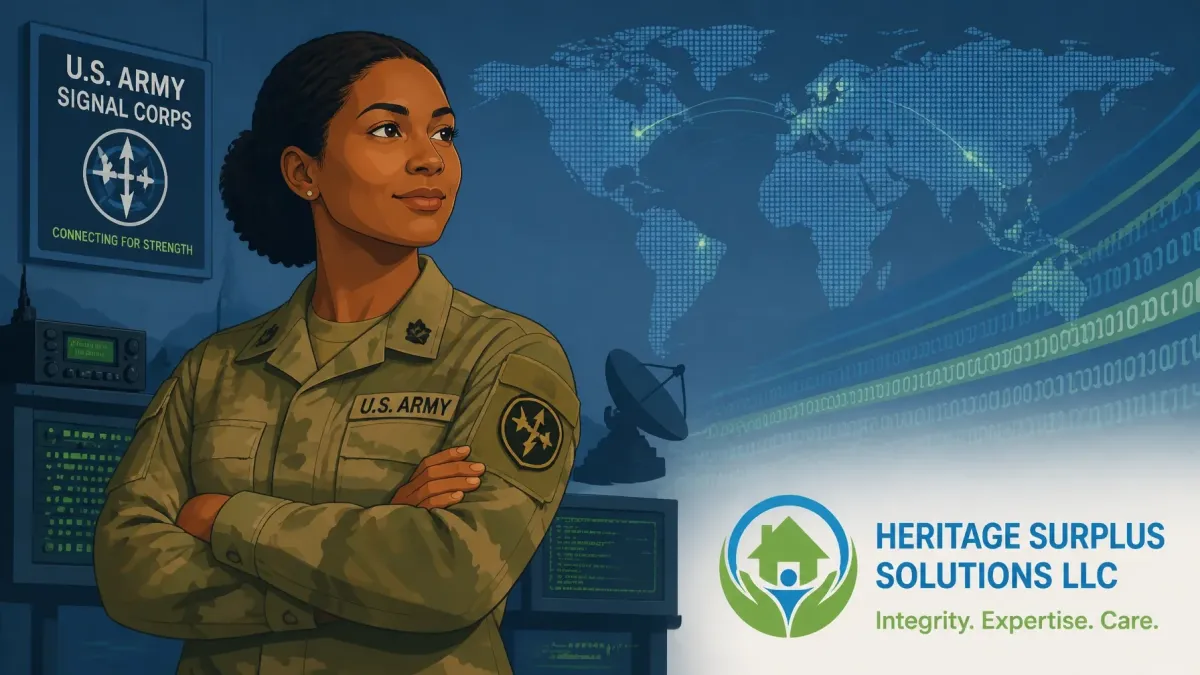
From Army Private to Staff Sergeant: What 8 Years in the Signal Corps Taught Me About Service, Red Tape, and Showing Up
Pull up a chair, grab a cup of coffee (or maybe some sweet tea if you’re feeling those southern roots like I am), and let’s chat.
If you caught the first part of this series, you know I grew up in East Alabama, Opelika and Auburn, to be exact. I was raised by a mom who didn't take "no" for an answer and taught me that "Always Forward" wasn't just a catchy phrase; it was a survival strategy. But today, I want to take you to the next chapter of my life.
It’s the chapter where an 18-year-old girl from Alabama stepped onto a bus, headed for Basic Training, and started a journey that would take her across the globe and eventually lead her right back here, helping people like you navigate the messy world of government red tape.
The Choice: Service and Sacrifice
When I graduated from high school in 1996, I had big dreams. I wanted college. I wanted to see the world. But I also saw the weight on my family’s shoulders. I knew that the cost of an education was a burden I didn’t want them to carry alone.
So, I did what a lot of young people in the South do, I walked into the recruiter’s office.
Joining the Army wasn’t just about the GI Bill, though. It was about a deep-seated need to serve, something that had been in my DNA since I was a candy striper at East Alabama Medical Center. I signed up for the Signal Corps, the branch of the Army responsible for all things communication and information. If the Army was a body, the Signal Corps was the nervous system.
I’ll be honest: Basic Training was a shock. But whenever it got tough, I’d hear my mother’s voice in my head. Get it done. No excuses. I learned quickly that showing up is 90% of the battle, and showing up with a plan is the other 10%.
From Alabama to Seoul: A World Reimagined
My first big assignment took me thousands of miles away to Seoul, South Korea. Talk about a culture shift! Coming from a small town in Alabama to a bustling metropolis like Seoul was eye-opening in the best way possible.
This was where I really started to develop my worldview. I realized that while our languages and customs might be different, people everywhere are mostly looking for the same things: respect, security, and a sense of community.
I spent a lot of my time at a tiny cafe right outside the post. It was owned by a wonderful woman named Mrs. Kim. She didn't just sell food; she shared her culture. Over bowls of steaming rice and spicy kimchi, Mrs. Kim taught me about the heart of Korea. Those meals weren't just about sustenance; they were lessons in empathy.

Working in Korea, and later getting the chance to work in Japan and Malaysia, taught me how to listen. Not just to the words people were saying, but to the needs beneath them. In the Signal Corps, my job was to make sure information flowed correctly. But in the real world, I was learning how to connect with people from all walks of life.
The Weight of Responsibility: OIF, OEF, and the 3rd Army
By the time the early 2000s rolled around, the world had changed. Operations Iraqi Freedom (OIF) and Enduring Freedom (OEF) were in full swing, and I found myself serving as the Chief of Information Management for the 3rd US Army.
That title sounds fancy, but here’s what it actually meant: I was responsible for the flow of data, the security of networks, and the integrity of the information that commanders used to make life-and-death decisions. I was a Staff Sergeant by then, and the weight of that responsibility was something I carried every single day.
This is where I learned my most valuable lesson for what I do today at Heritage Surplus Solutions: How to navigate "The System."
The military is the world’s biggest bureaucracy. There are forms for everything. There are "proper channels" that feel like mazes designed to keep you out. There is enough red tape to wrap around the moon twice. As Chief of Information Management, it was my job to cut through that tape. If a unit in the field couldn't communicate, I had to find out why, find the right person to fix it, and stay on them until it was done.
I didn't take "it’s not in the manual" for an answer. I learned how to find the person behind the desk who actually had the power to say "yes."
Why This Matters to You
You might be wondering, "Kristie, that’s a cool story, but what does the Signal Corps have to do with my foreclosure surplus funds?"
The answer is: Everything.
When you lose a home to foreclosure, the government often ends up holding onto money that belongs to you, the "surplus" or "overage" from the sale. But they don't exactly make it easy to get that money back. Just like the military, the world of tax and mortgage foreclosures is buried under mountains of paperwork, confusing state laws, and government agencies that aren't always in a hurry to help you.

When I work on a claim for a client today, I'm using the exact same skills I honed as a Staff Sergeant:
Integrity: In the Signal Corps, if the data wasn't accurate, people got hurt. At Heritage Surplus, we treat your claim with that same level of gravity. We do what we say we're going to do.
Expertise: I spent eight years learning how to manage complex systems and sensitive information. I know how to track down funds that "don't exist" and how to file paperwork that actually gets processed.
Persistence: I don't give up. If a county treasurer or a court clerk tells us "no" or puts us in a loop of "check back later," I know how to push back. I’ve dealt with much bigger bureaucracies than a local county office!
Always Forward
I was honorably discharged in 2004 as a Staff Sergeant. I left the Army with a chest full of pride and a head full of knowledge. But more than that, I left with a heart for people.
I saw how easy it is for an individual to get lost in a massive system. I saw how intimidating it can be to stand up and say, "Hey, this is mine, and I need your help to get it back."
That’s why I started Heritage Surplus Solutions. I wanted to take all that "Big Army" experience and use it for the "little guy." I wanted to be the advocate for the person who feels overwhelmed by the red tape.

If you’re struggling with the aftermath of a foreclosure, or if you think there might be money out there with your name on it, don't let the bureaucracy scare you. You’ve got a Staff Sergeant in your corner now.
We handle the attorneys, the notaries, the government agencies, and the mountains of forms: and we do it all with no upfront cost to you. Because just like in the Army, I believe in mission success. And our mission is getting your money back into your pocket.
Next time, I'll tell you about how I took these skills into the high-tech world of Google and the FBI. But for now, just remember: no matter how tangled the red tape looks, there's always a way through.
Always Forward,