How Long Does a Foreclosure Stay on Your Credit? (And What You Can Do Right Now)
Hey there. If you’re reading this, you’ve likely been through a lot lately. Dealing with a foreclosure is one of the most stressful things a person can go through: it’s not just a financial hurdle, it’s an emotional one too.
One of the biggest worries we hear from our friends and clients at Heritage Surplus Solutions is: "Is my credit ruined forever?"
The short answer is a loud, resounding no. But there is a timeline you need to know about, and more importantly, there are things you can do right now to start turning the ship around. Grab a coffee, take a deep breath, and let’s talk about how to get your financial groove back.
The Big Question: How Long Does It Actually Stay?
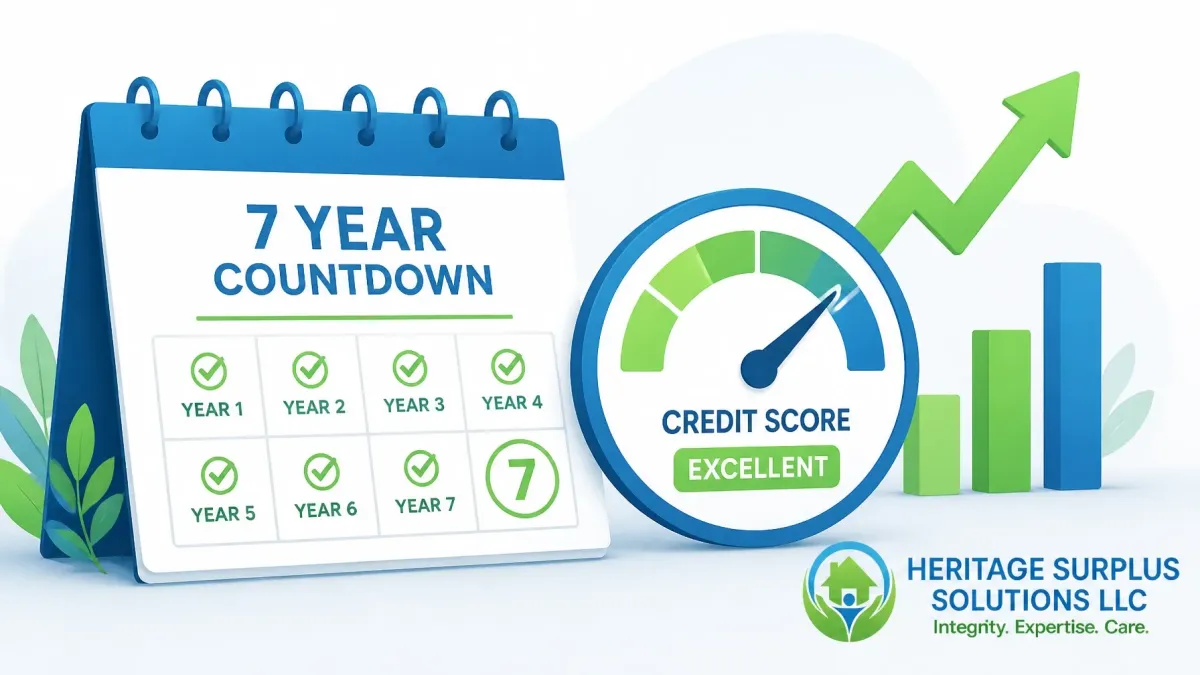
Let’s get the "scary" number out of the way first. Under the Fair Credit Reporting Act (FCRA), a foreclosure will stay on your credit report for seven years.
I know, seven years sounds like a lifetime when you’re standing at the beginning of it. But here’s the secret the big banks don’t always emphasize: The impact of that foreclosure fades over time.
Your credit score takes its biggest hit the moment the foreclosure is recorded (usually between 100 to 160 points, depending on where you started). However, as the years tick by, that "derogatory mark" carries less and less weight: provided you’re building new, positive habits on top of it.

When Does the "7-Year Clock" Actually Start?
This is a common point of confusion. Many people think the seven years starts when they move out or when the house is sold at auction.
Actually, the clock starts on the date of the first missed payment that led to the foreclosure.
For example, if you stopped being able to pay in January 2026, and the foreclosure wasn't finalized until October 2026, the seven-year countdown usually starts from that January date. By early 2033, that mark should automatically drop off your report like it was never there.
4 Things You Can Do Right Now to Rebuild
You don’t have to sit around and wait for seven years to pass. Rebuilding your credit is a proactive game. Here is your "Right Now" action plan:
1. Check Your Reports for Errors
Believe it or not, credit bureaus make mistakes. Sometimes a foreclosure is listed twice, or the dates are wrong. You are entitled to a free credit report from each of the three major bureaus (Equifax, Experian, and TransUnion) every year via AnnualCreditReport.com.
If you see something that isn't right, dispute it! Cleaning up errors is the fastest way to see a "mini-boost" in your score.
2. The Power of the Secured Credit Card
If your credit score is too low for a standard card, look into a secured credit card. You give the bank a small deposit (say, $200), and that deposit becomes your credit limit.
Use it for something tiny, like a streaming subscription.
Pay it off in full every single month.
Why it works: It proves to the bureaus that you are responsible with credit again.

3. Focus on the "Big Two"
Your credit score is mostly made up of two things: Payment History (35%) and Credit Utilization (30%).
Payment History: Set every bill you have: phone, utilities, insurance: to autopay. Even one late payment can stall your recovery.
Utilization: Try to keep your credit card balances below 10% of your limit. If you have a $500 limit, don't carry a balance of more than $50.
4. Use Your Surplus Funds Wisely
If you’ve worked with us at Heritage Surplus Solutions and successfully recovered unclaimed foreclosure overages, you suddenly have a "financial cushion."
Instead of spending that surplus all at once, consider using a portion of it to:
Pay off high-interest collections or old debts.
Fund the deposit for a secured credit card.
Build a small emergency fund so you never have to rely on high-interest loans again.
Myth-Busting: "I'll Never Own a House Again"
We hear this all the time, and it’s simply not true. While a foreclosure stays on your credit for seven years, many loan programs (like FHA or VA loans) may allow you to apply for a new mortgage in as little as two to three years after a foreclosure, provided you’ve spent that time diligently rebuilding your credit.
You can read more about the road back to homeownership in our FAQ section.

The Bottom Line
Foreclosure is a major life event, but it is not a life sentence. It’s a chapter in your story, and you’re already writing the next one by looking for answers today.
At Heritage Surplus Solutions, we’re here to help you find the silver lining: specifically the money that might be waiting for you after a foreclosure sale. Reclaiming those funds is a great first step toward your new financial future.
If you want to see if you’re owed money from a past foreclosure, or just want to chat about the process, reach out to us here. We’ve got your back.
