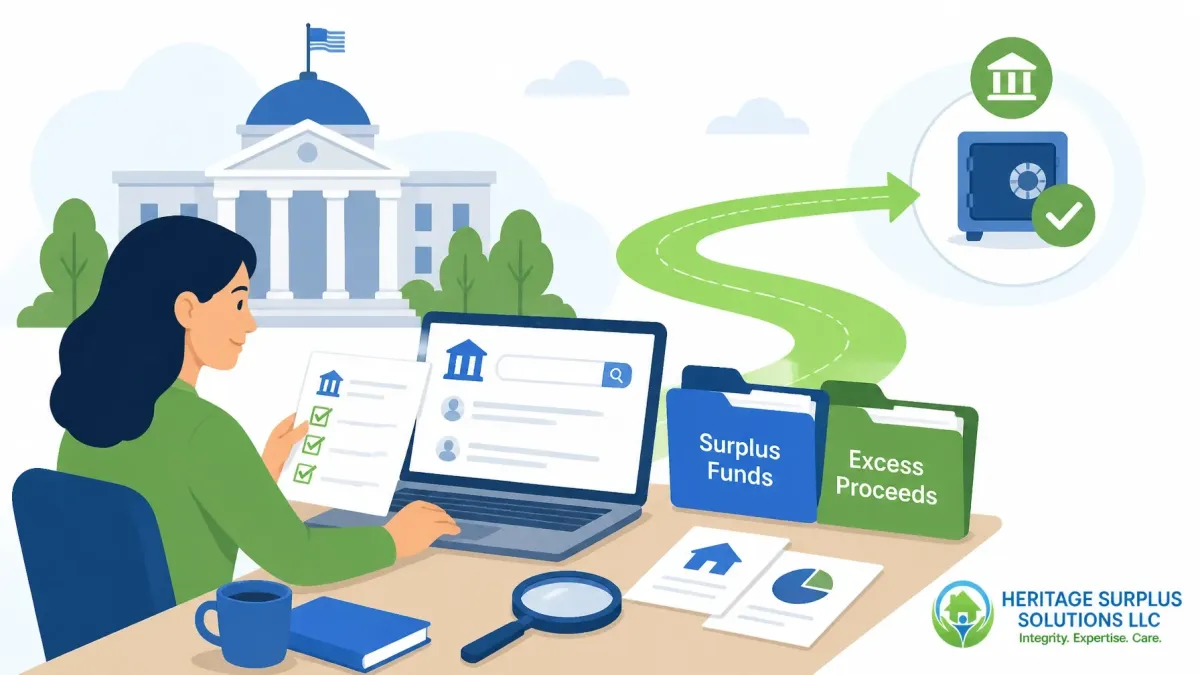
How to Find Out Whether Your County Is Holding Foreclosure Surplus Funds
If your home was sold through a foreclosure or tax sale, you may still have an important question hanging over you:
Did the sale produce extra money, and is your county holding it for you?
This leftover money may be called surplus funds, excess proceeds, foreclosure overage, or overbid funds. It generally exists when a property sells for more than the amount needed to pay the mortgage, taxes, foreclosure expenses, and other approved costs.
Finding out whether money is waiting for you can take some digging, especially because every state and county handles the process differently. But you can start with a few practical steps.
First, understand what kind of sale took place
The office holding the money usually depends on the type of foreclosure sale.
Mortgage foreclosure or sheriff’s sale
A mortgage foreclosure is usually connected to a lender, court case, or sheriff’s sale. Records may be held by:
The county clerk of court
The sheriff’s civil or foreclosure division
The court accounting office
A court-appointed trustee, depending on the state
For example, King County, Washington explains that its Treasury handles excess funds from tax foreclosure auctions, but mortgage foreclosure or sheriff’s sale questions should go to the Superior Court Accounting Office instead.
Tax foreclosure or tax sale
A tax foreclosure happens when property taxes remain unpaid. The sale may be handled by:
The county treasurer
The tax collector
The county finance department
The revenue or delinquent-tax office
Tax-sale surplus may be listed separately from mortgage foreclosure funds. So, knowing which type of sale occurred will help you contact the right office the first time.
Know the different terms counties may use
Searching only for “foreclosure surplus funds” may not bring up the right page. Counties often use different language, including:
Surplus funds
Excess proceeds
Excess funds
Excess auction money
Foreclosure overage
Overbid funds
Tax sale surplus
Unclaimed foreclosure funds
Unclaimed property
When searching online, combine these terms with the county name. Try searches such as:
[County name] surplus funds[County name] excess proceeds[County name] foreclosure overage[County name] tax sale excess funds[County name] sheriff foreclosure surplus
Use the county’s official website whenever possible. Government websites typically end in .gov, but some official county websites use other domains. Check that you are on the real county website before sharing personal information.

Gather these records before you start
You do not need every document in the world to make an initial inquiry. However, having a few key details ready can make the search much easier.
Try to collect:
The property’s former address
The county and state
Your name as it appeared on the property records
The parcel number, also called an APN or assessor’s parcel number
The approximate foreclosure or tax-sale date
The foreclosure case number, if you have it
Your former lender’s name
The name of any other owner listed on the deed
The sale notice, court paperwork, or tax-sale paperwork
Your current mailing address
A copy of your photo identification, if the county requests it
If the former homeowner has passed away, heirs should also gather documents showing their connection to the estate. These may include a death certificate, will, probate records, letters of administration, or other documents required by the state.
Do not send sensitive documents to a company or individual until you have verified who they are and why the information is needed.
Search the county’s online records
Many counties publish surplus information online. The list may appear as:
A searchable database
A PDF organized by sale year
A spreadsheet
A “sold properties” list
A court docket or case record
A notice of excess proceeds
Once you find the right page, search for your last name, parcel number, former property address, or foreclosure case number.
Some lists show only basic information. Others may include the estimated surplus amount, auction date, or instructions for filing a claim.
For example, King County publishes tax-foreclosure excess-funds lists by auction year and says the funds are held for three years from the auction date. Los Angeles County’s Treasurer and Tax Collector also publishes excess-proceeds lists and claim instructions for certain tax-defaulted property sales. The county explains that eligible parties may file directly without paying an agent.
These examples are helpful, but they are not universal rules. Your county may use a different process.
What if your county does not publish a list?
Do not assume that no online list means no money exists.
Some counties provide surplus information only when you contact the appropriate office. Others may require a public-records request.
Start by calling the office that handled the sale. Use the phone number listed on the county’s official website, not a number printed on an unsolicited letter, postcard, or email.
You can ask:
> “I am trying to find out whether surplus funds or excess proceeds are being held from a foreclosure or tax sale involving [property address]. Which office handles these records, and what information do you need from me?”
If the county asks you to submit a written request, you can use wording like this:
> “Please provide any surplus funds, excess proceeds, overage, or unclaimed funds information related to the property at [address], parcel number [number], sold on or around [date]. Please also identify the office currently holding the funds and the deadline and instructions for filing a claim.”
Keep copies of everything you send. If you speak with someone by phone, write down the date, department, representative’s name, and instructions you received.
Check the state’s unclaimed-property database
Sometimes surplus funds do not remain with the county forever. After a state-specific period, unclaimed money may be transferred to a state treasury, comptroller, or unclaimed-property division.
If the county tells you it no longer holds the funds, ask:
Which state agency received the money?
Under what name was it reported?
What date was it transferred?
Is there a claim number or property reference?
What documents are required to recover it?
Then visit the state agency’s official website and search there. Search under the former homeowner’s full legal name, previous address, business name, and: where allowed: the names of possible heirs.
In Florida, for example, Florida Statutes section 45.032 addresses the disbursement of surplus funds after a judicial sale and explains that funds remaining with the clerk may later be treated as unclaimed property. The exact process depends on the facts of the case and the applicable law.
Pay close attention to deadlines
This is one of the most important parts of the process.
There is no single nationwide deadline for claiming surplus funds after foreclosure. The time limit may depend on:
The state
The county
The type of sale
Whether the sale was judicial or nonjudicial
Whether there are liens or competing claims
Whether the funds have moved to a state agency
Whether the claimant is the former owner, an heir, or another interested party
Some jurisdictions use a deadline measured from the sale date. Others use a fixed calendar date or a deadline connected to the county’s notice.
When you contact the county, ask clearly:
> “What is the final date to file a claim for these funds?”
Ask for the answer in writing. If the deadline is approaching, do not wait to finish every part of your research before contacting the office. Find out how to preserve your claim and what documents can be submitted later.
Be careful with scams and pressure tactics
People looking for foreclosure surplus recovery are often contacted during an already stressful time. Unfortunately, scammers know that and may use official-looking letters, urgent phone calls, or promises of guaranteed money.
Watch for red flags such as:
Requests for large upfront fees
Pressure to sign immediately
Requests to wire money or buy gift cards
Promises that recovery is guaranteed
A refusal to let you contact the county yourself
Requests for bank passwords or unnecessary account information
A contract that does not clearly explain fees
Claims that the company is a government agency
A demand that you sign over ownership of your claim without an explanation
A legitimate service should give you time to review an agreement and understand what you are signing. You should also be able to verify that the surplus funds exist through the county or state office.
How Heritage Surplus Solutions can help
You can pursue a claim yourself. But the process may become complicated when there are multiple heirs, old liens, missing records, probate issues, or strict court filing requirements.
At Heritage Surplus Solutions, we handle the full-service recovery process for clients. That may include:
Locating possible surplus funds
Contacting county and state agencies
Reviewing available records
Preparing claim paperwork
Coordinating required notaries
Working with attorneys when appropriate
Helping navigate state-specific rules and deadlines
There is no upfront cost. Clients pay only if funds are successfully recovered, according to the agreement they review and sign. We also encourage clients to ask questions and have any agreement reviewed by an attorney or trusted adviser before signing.
You can learn more about how the foreclosure surplus recovery process works, review our frequently asked questions, or contact Heritage Surplus Solutions to discuss your situation.

Your simple next-step checklist
If you are ready to begin, follow this order:
Write down the property address, county, sale type, and approximate sale date.
Find the county office that handled the foreclosure or tax sale.
Search the official website for “surplus,” “excess proceeds,” and “overage.”
Look for your name, parcel number, case number, or former address.
Call the office directly if no list is available.
Ask for the exact claim deadline in writing.
Find out whether the money has been transferred to state unclaimed property.
Gather identification, ownership, and heirship documents.
Verify every company, deadline, and fee before signing anything.
Submit your claim promptly and keep copies of your records.
Finding surplus funds may take patience, but you do not have to figure out every step at once. Start with the county office, ask clear questions, and protect yourself from pressure. If money is being held from the sale of your former home, taking action could help you recover funds that may make a meaningful difference in your next chapter.