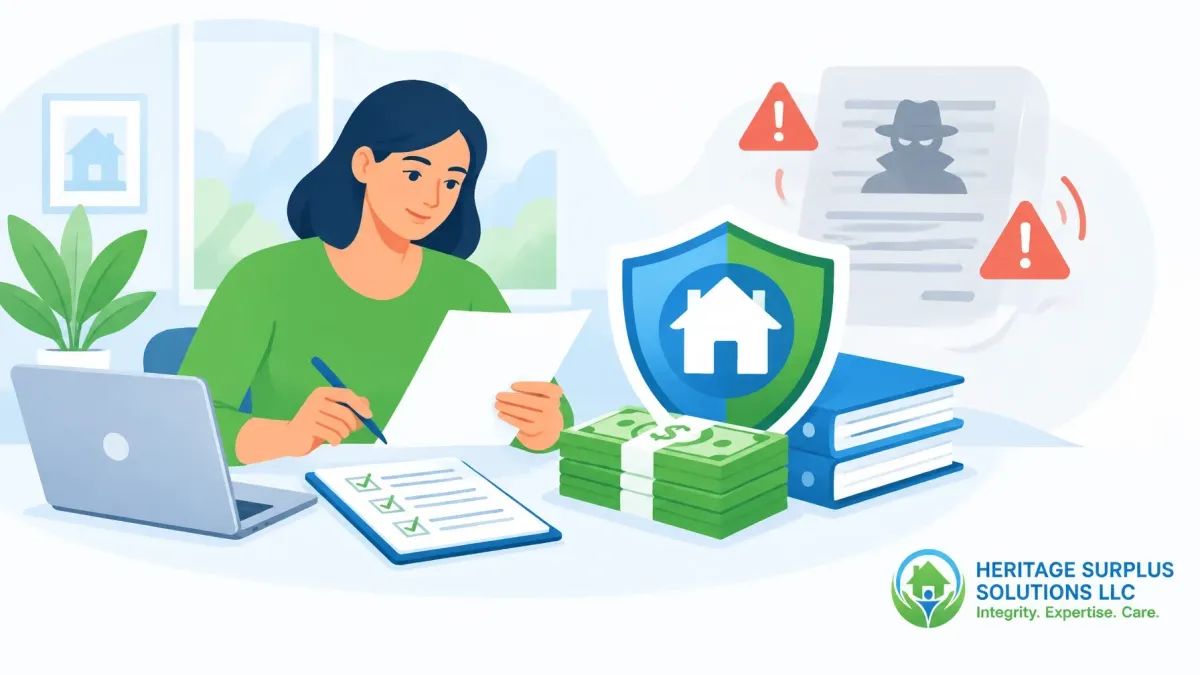
How to Protect Your Surplus Funds From Predatory Buyers and Assignment Traps
If your property was sold in a tax or mortgage foreclosure, you may have heard the words surplus funds, foreclosure overage, or excess proceeds. These terms generally describe money left after a foreclosure sale pays the amounts required by the judgment, loan, taxes, liens, and sale expenses.
That money may belong to you, or, in some cases, to heirs or other people with a legal interest in the property.
Unfortunately, people who have recently gone through foreclosure are often contacted quickly by companies or individuals promising to “help” recover the money. Some services are legitimate. Others use pressure, confusing contracts, or aggressive sales tactics to take far more than necessary.
So, grab a coffee and let’s talk about how to protect yourself.

Why foreclosure surplus funds attract aggressive buyers
Foreclosure records are often public. That means companies may search those records and contact former homeowners soon after a sale. The timing can be especially troubling because foreclosure is already an exhausting and emotional experience.
A caller may know:
Your name
Your former property address
The date of the foreclosure sale
That a possible surplus exists
An estimated amount of money involved
That knowledge can make the caller sound official. But knowing public information does not automatically mean the person is connected with the court, county, lender, or government.
You have the right to slow down, ask questions, compare options, and seek legal advice before signing anything.
Seven red flags to watch for
1. Upfront fees or requests for payment before recovery
Be cautious if someone asks you to pay a large fee before they begin. This may be called a:
Processing fee
Research fee
Retainer
Filing fee
Membership fee
“Guaranteed” administrative charge
Some claims may involve legitimate court, notary, recording, or document costs. The important question is who pays those costs, when they are due, and whether the agreement explains them clearly.
A trustworthy service should explain every possible expense before you sign. You should never feel pressured to send cash, gift cards, cryptocurrency, or sensitive banking information to get started.
At Heritage Surplus Solutions, clients do not pay upfront. Our model is no recovery, no fee. We are paid only if we successfully recover funds for you.
2. High-pressure same-day signing
A legitimate professional should not be upset because you want time to read a contract.
Be careful if someone says:
“This offer expires today.”
“You have to sign right now.”
“Another buyer is ready to take your place.”
“You will lose the money if you do not sign immediately.”
“Do not show this agreement to anyone.”
Pressure is a warning sign, especially when the document transfers rights to money you may be entitled to receive.
Take the contract home. Read every page. Ask for a copy. If possible, have an independent attorney review it before you sign.
3. Promises of guaranteed eligibility or a specific payout
No honest company can promise a specific payout before reviewing the complete case.
The amount available may change because of:
Mortgage balances
Property taxes
Junior liens
Judgments
Homeowners’ association claims
Bankruptcy issues
Competing claims
Court costs
The final disbursement records
A caller may say, “You are guaranteed to receive $50,000.” That statement should make you pause. A more responsible explanation would be: “Public records suggest a possible surplus, but the final amount and entitlement must be verified.”
4. Blank or overly broad powers of attorney
A power of attorney can give another person authority to act for you. Some limited powers of attorney may be appropriate in specific situations, but a blank or broad document can create serious risks.
Never sign a document that:
Has blank sections
Does not clearly identify the case
Gives authority over all your finances
Allows someone to sell or transfer property
Does not explain when the authority ends
Lets another person sign documents without your review
If a power of attorney is presented, ask exactly what it authorizes, how long it lasts, and whether it applies only to the surplus claim. An independent attorney should review it before you sign.
5. Assignment-of-rights language hidden in the contract
An assignment may transfer your legal right to pursue or receive surplus funds to another person or company.
Watch for words such as:
Assign
Transfer
Sell
Convey
Release
Relinquish
Grant
All rights, title, and interest
Power to collect on my behalf
You may think you are signing a simple assistance agreement when you are actually signing away your claim.
An agreement should state plainly whether you are assigning any rights. If you are not comfortable transferring your rights, do not sign until you understand the legal effect.
6. Cold calls shortly after foreclosure
Contact soon after a foreclosure is not automatically proof of fraud. However, it is a reason to be careful.
A company that contacts you immediately may know that you are stressed, displaced, or worried about money. That can create an unfair advantage during negotiations.
You do not have to discuss your situation on the first call. You can say:
> “Please send me the information in writing. I will review it and get back to you.”
Then independently verify the company’s identity, website, address, contract, fee structure, and licensing information where applicable.
7. Refusing to explain fees
If a company will not clearly answer “How much will this cost me?” do not sign.
A transparent agreement should explain:
The percentage or flat fee
Whether the fee is calculated before or after expenses
Who pays filing, notary, attorney, or recording costs
Whether fees are owed if no funds are recovered
When payment is due
What happens if another claimant receives the funds
Whether the agreement can be canceled
Whether you are assigning your rights
Vague phrases like “standard fees,” “reasonable compensation,” or “a portion of the recovery” are not enough.

You may not need to hire anyone
In many states, the property owner can file a surplus claim directly. You may not have to hire a recovery company, assign your rights, or sign a power of attorney.
The exact rules depend on the state, county, type of foreclosure, and facts of the case. Always check the instructions from the court, clerk, trustee, or other government office holding the funds.
Florida offers a helpful example. Under Florida Statutes Sections 45.032 and 45.033, the owner of record is generally presumed entitled to surplus funds after timely claims by subordinate lienholders are addressed.
Florida’s statutory owner claim language also explains that the owner does not have to hire a lawyer or another representative and does not have to assign rights to someone else to claim money they may be entitled to receive. Florida also places specific requirements on voluntary assignments, including written disclosures, court filing requirements, and a limit on compensation in qualifying assignments. You can review the assignment provisions in Section 45.033.
This is a Florida example, not a rule for every state. The takeaway is simple: do not assume that a caller is the only person who can help you.
You can also review our guides on whether you need a professional to claim surplus funds and how to approach a DIY surplus claim.
What does a fair agreement look like?
If you decide to work with a professional, the agreement should be easy to understand. It should identify the parties, the specific foreclosure case, the services being provided, and the exact compensation.
A fair agreement should:
Avoid upfront fees whenever possible
Explain the fee in dollars and percentages
State when the fee becomes due
Clearly describe reimbursable expenses
Avoid blank sections
Avoid unnecessary powers of attorney
State whether rights are being assigned
Give you time to review before signing
Allow independent legal review
Avoid guaranteed promises about eligibility or payout
Explain what happens if no funds are recovered
You should receive a complete copy of everything you sign.
If the agreement is difficult to understand, that is not a reason to rush. It is a reason to ask questions.
Why independent legal review can help
A surplus funds claim may look simple, but competing lienholders, heirs, bankruptcy, probate, and state-specific rules can make the situation complicated.
An independent attorney, one who does not work for the recovery company, can help explain:
Whether the contract assigns your rights
Whether the fee is reasonable
Whether the power of attorney is too broad
Whether you have a direct filing option
Whether someone else may have a claim
Whether the agreement creates obligations beyond the surplus case
You do not need permission from a recovery company to seek independent advice.

How Heritage Surplus Solutions approaches your claim
At Heritage Surplus Solutions, we believe you deserve clear information, not pressure.
We help with the time-consuming work involved in foreclosure surplus recovery, including researching records, contacting government agencies, preparing claim paperwork, coordinating notaries and attorneys when needed, and navigating state requirements.
Our approach is:
No upfront cost
No recovery, no fee
Clear written agreements
No guaranteed payout promises
Compassionate communication
Education about your options
You can learn more through our FAQ page, About page, or contact our team.
We also have a DIY Surplus Claim Kit coming soon for people who want practical guidance while handling a straightforward claim themselves. Whether you choose to file on your own or work with a professional, our goal is to help you make an informed decision.
What to do if you already signed something
Do not panic. Gather every document, text message, email, and letter connected with the agreement.
Then:
Read the contract carefully.
Look for assignment and power-of-attorney language.
Write down the promised fee and any amount you were quoted.
Ask whether the document has been filed with the court.
Contact an independent attorney for advice.
Reach out to the appropriate court or clerk for case information.
Avoid signing anything else until you understand the first agreement.
The rules for canceling or challenging an agreement vary. A lawyer can explain your options based on your state and circumstances.
The bottom line
Your foreclosure may have taken your home, but it does not mean you should give away your remaining rights without understanding what you are signing.
Slow down. Ask questions. Never sign blank paperwork. Be cautious with assignments, broad powers of attorney, upfront fees, same-day pressure, and promises that sound too good to be true.
You may be able to file a claim yourself. If you prefer help, choose a service that explains its fees, respects your choices, and is paid only after funds are successfully recovered.
Your money and your decision deserve both integrity and care.