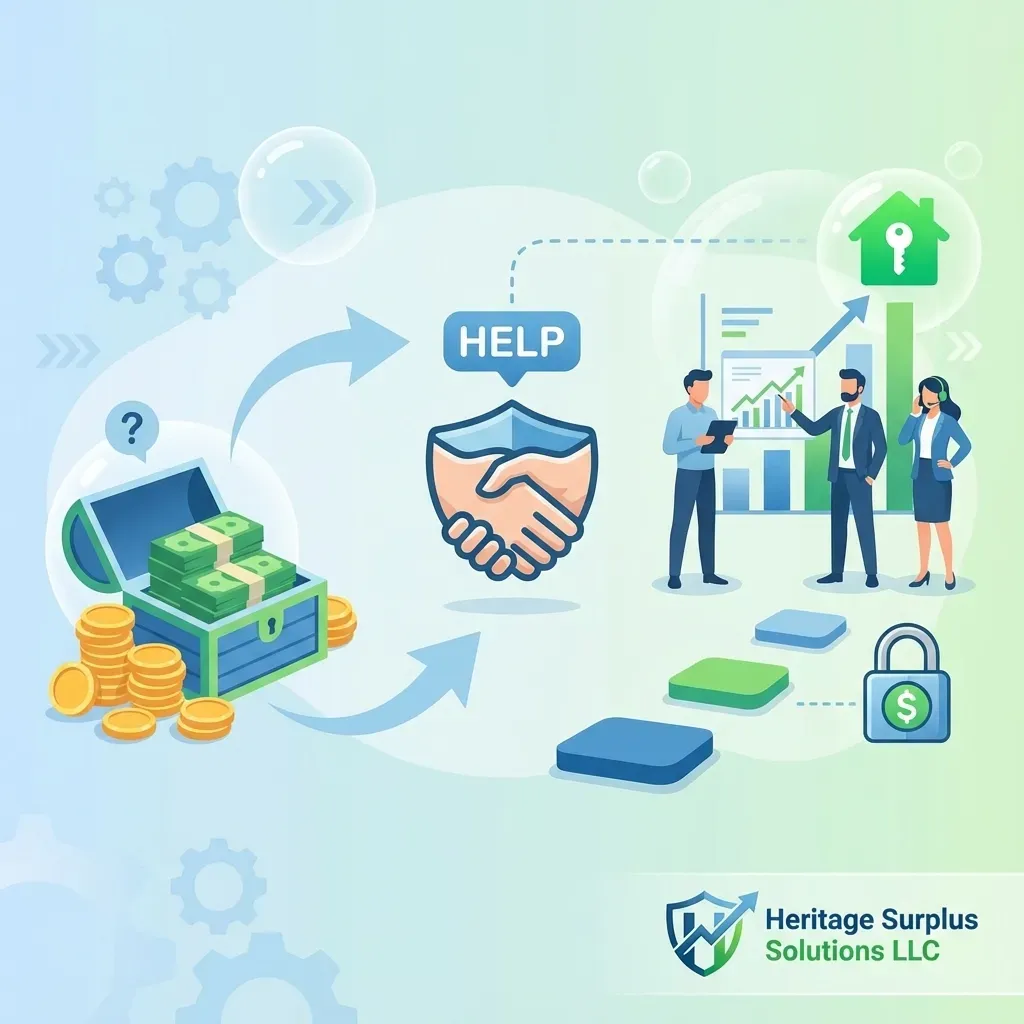
Illustration showing the financial assistance process, featuring a treasure chest filled with money leading to a handshake labeled “Help,” which then connects to professionals analyzing growth charts and a house key symbol. Additional icons include stacked coins, security locks, and step blocks. The Heritage Surplus Solutions LLC logo appears in the corner.

When to Get Help With Surplus Funds , and What Real Help Looks Like

December 22, 20258 min read

heroImage

You've just discovered that foreclosure surplus funds might be owed to you after losing your home. Maybe a friend mentioned it, or you stumbled across information online. Now you're facing a confusing maze of legal processes, court documents, and conflicting advice about whether you need professional help.

I get it. You're already dealing with the emotional and financial aftermath of foreclosure. The last thing you want is to make another costly mistake or get taken advantage of by someone promising easy money.

Here's the truth: sometimes you absolutely can handle the surplus recovery process yourself, and sometimes you really do need expert guidance. The key is knowing which situation you're in , and what legitimate help actually looks like when you need it.

The Common Confusion Around Getting Help

Most people who discover they might be owed foreclosure surplus funds immediately face two overwhelming questions: "Can I do this myself?" and "Who can I trust to help me?"

This confusion is completely understandable. The surplus recovery process involves legal documents, court procedures, and deadlines that can feel intimidating if you've never dealt with them before. Add in the fact that you're already stressed from the foreclosure experience, and it's natural to wonder whether you're in over your head.

What makes this even more challenging is that there's no shortage of people reaching out offering to "help" , some legitimate, many not. You might receive calls, letters, or emails from companies claiming they can recover your surplus funds for a hefty fee. Some demand upfront payments. Others promise unrealistic timelines or guaranteed results.

image_1

Meanwhile, well-meaning friends and family members might give conflicting advice. Some say "just hire someone to handle it," while others insist "you don't need to pay anyone , do it yourself!"

The reality is that both approaches can be right, depending on your specific situation. What you need is clarity about when each approach makes sense.

When You Can Handle Surplus Recovery Yourself

Let's start with the good news: many surplus fund recoveries are straightforward enough for you to handle on your own. If your situation fits these criteria, you probably don't need professional assistance:

Your case is relatively simple.This typically means you were the sole owner of the property, there are no complex liens or legal disputes, and the surplus amount is clearly documented in the court records.

You have time and patience for paperwork.The DIY approach requires gathering documents, filling out forms correctly, and potentially making trips to the courthouse. If you can dedicate the time and don't mind detailed paperwork, you can save money by handling it yourself.

You're comfortable with basic legal procedures.You don't need to be a lawyer, but you should be comfortable reading court documents, following written instructions, and communicating with court clerks when you have questions.

The deadline isn't approaching rapidly.Most surplus fund claims have specific time limits. If you have plenty of time before the deadline, you can afford to take the slower DIY approach and learn as you go.

You can access all necessary documents easily.This includes things like your identification, proof of ownership, and any required documentation from the foreclosure sale. If these are readily available, the process becomes much more manageable.

For cases that meet these criteria, going the DIY route can save you significant money in professional fees while giving you complete control over the process.

Red Flags That You Need Professional Help

However, some situations are complex enough that trying to handle them alone could result in costly mistakes or missed deadlines. You should seriously consider getting help if you encounter any of these red flags:

Multiple owners or inheritance issues.If the foreclosed property had multiple owners, was owned by a trust, or involves inheritance issues, the legal requirements become significantly more complex. One wrong step could invalidate your entire claim.

Competing claims from other parties.Sometimes multiple people believe they're entitled to the same surplus funds. If you discover other potential claimants, you'll likely need legal expertise to navigate the competing claims process.

Time is running short.If the deadline for filing your claim is approaching quickly, professional help can expedite the process and ensure you don't miss critical deadlines due to procedural delays.

Complex lien or debt situations.If there were multiple mortgages, complex liens, or disputes about what was owed on the property, determining the correct surplus amount and your entitlement requires expertise.

You're overwhelmed by the legal language.If reading the court documents and legal requirements feels completely overwhelming, don't risk making mistakes that could cost you the entire recovery.

Previous DIY attempts have failed.If you've already tried to file your claim and it was rejected or you've encountered roadblocks you can't resolve, it's time to get professional guidance.

image_2

What Legitimate Professional Help Looks Like

When you do need help with foreclosure surplus funds recovery, it's crucial to know what legitimate assistance looks like versus the scams and predatory practices that unfortunately target people in your situation.

Legitimate professionals are transparent about their process.They'll explain exactly what they'll do, what documents are needed, and what the timeline looks like. They won't make vague promises or refuse to answer your questions about their methods.

They charge reasonable, clearly explained fees.Legitimate surplus recovery professionals typically work on a contingency basis, meaning they only get paid if they successfully recover your funds. Their fee structure should be clearly explained in writing, usually ranging from 25-50% of the recovered amount.

They never ask for upfront payments.This is a major red flag. Legitimate professionals understand that if you had extra money lying around, you probably wouldn't have gone through foreclosure in the first place. They should be willing to front the costs and get paid from the successful recovery.

They have verifiable credentials and references.Look for professionals who are licensed attorneys, paralegals working under attorney supervision, or companies with established track records. They should be able to provide references or examples of successful recoveries.

They communicate regularly and professionally.Good professionals keep you informed throughout the process, return your calls promptly, and treat you with respect. You should never feel pressured or kept in the dark about your case's progress.

They're honest about potential challenges.If your case has complications, legitimate professionals will discuss these upfront rather than promising easy success. They'll also be honest if they don't think professional help is necessary for your situation.

Questions to Ask Before Hiring Help

Before working with any professional, ask these important questions:

Trust your instincts. If something feels off about their answers or their approach, keep looking.

Making the Right Decision for Your Situation

The decision between DIY and professional help ultimately comes down to honestly assessing your situation, your capabilities, and what's at stake.

Consider the size of the surplus funds involved. If you're dealing with a small amount and the process seems straightforward, the DIY approach might make the most financial sense. However, if significant money is involved and your case has complications, professional fees could be a worthwhile investment to ensure success.

Also factor in your stress level and bandwidth. Going through foreclosure is emotionally exhausting. If taking on another complex project feels overwhelming, there's value in having a professional handle the process while you focus on rebuilding your financial stability.

Remember, this isn't an all-or-nothing decision. You might start with the DIY approach and seek professional help if you encounter complications. Alternatively, you could consult with a professional initially to assess your case's complexity, then decide whether to proceed on your own or hire them for full representation.

Your Next Steps Toward Recovery

Whether you choose the DIY route or professional assistance, the most important step is getting started with accurate, comprehensive information about the surplus recovery process.

Understanding exactly what's involved, what documents you'll need, and what pitfalls to avoid gives you the confidence to either handle the process yourself or the knowledge to choose the right professional help.

The confusion and uncertainty you're feeling right now is normal, but it doesn't have to paralyze your progress toward recovering funds that rightfully belong to you.

Book Cover Image

If you're ready to gain clarity about your options and understand exactly what the surplus recovery process entails, "The Ultimate Guide to Foreclosure Surplus Funds" provides the comprehensive roadmap you need. This guide walks you through every step of determining whether you can handle recovery yourself or when professional help is your best option.

Don't let confusion or fear prevent you from reclaiming what's yours. Download your copy today and take the first confident step toward turning your foreclosure experience into an opportunity for financial recovery.

Remember: you deserve to reclaim what's rightfully yours, and with the right information, you can make the best decision for your unique situation.

Back to Blog